
Read time: 6 min.
Most women want to feel confident or feel more confident.
Most of us were taught it's something you either have or you don't.
My client Denise said it better than I could: confidence is not something we're born with. We create it.
Here's how she did it.
A Client Story about Confidence
I hadn't heard from Denise in over two years.
Then one morning, this voice note landed in my Instagram DMs. (shared with permission)
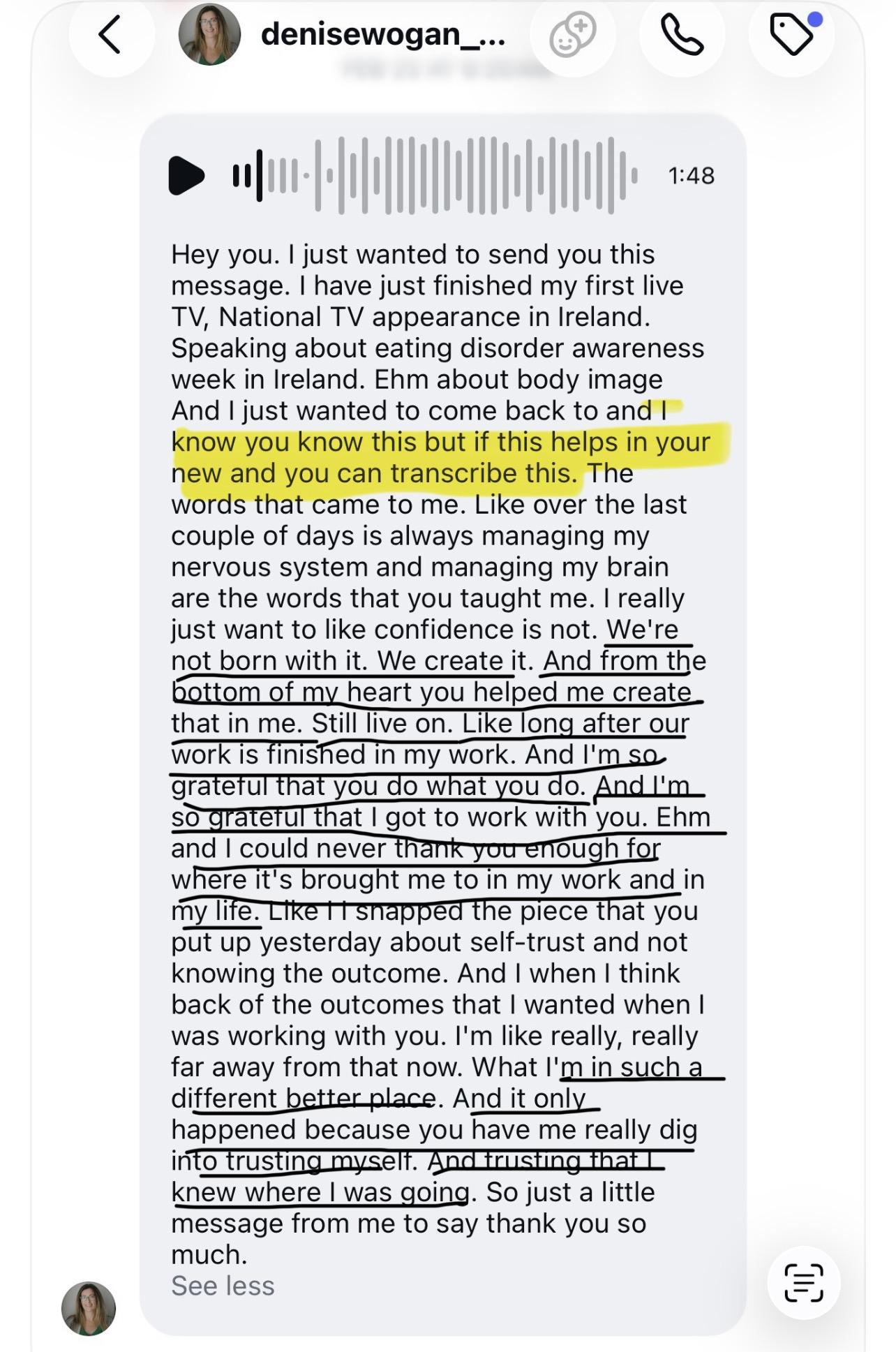
She had just walked off her first live national TV appearance in Ireland. She was sitting in her car, still shaking, and the first person she thought of was me.
I worked with Denise four years ago, for about a year and a half. So i decided to invite her to record a podcast episode to catch up. Listen here. Before we recorded our podcast conversation, I pulled out my old client notes. Her number one goal when we started working together was, in her own words:
"Feel confident in myself so that I can build a business, because right now I'm scared shit."
She didn't believe she was good enough to build a business. Some days she didn't believe she was good enough to be a coach at all.
Four years later, she has her own practice, she's opening her own clinic, and she was on national television as the expert.
When I read her old goal back to her, she said: "I'm taking a big step in my business this year, and it's the least scared I've ever felt. I'm risking a lot to do it, but I don't feel scared."
What Most People Do to Feel Confident
When it comes to confidence, most of the advice out there is some version of fake it till you make it.
Act confident until you feel it. Say yes to what everyone expects of you. Keep the peace. Please people so nobody rejects you.
What that really is, is an attempt to control your environment. If everyone around you approves, you get to feel okay.
It doesn't work. You can't control other people's opinions, so you end up exhausted from trying.
And here's why so many women keep trying anyway [insert years trying to be thin]
When the voice inside your head is harsh and self-critical, the only place left to find relief is outside of yourself. Other people's approval becomes the substitute for the support you're not giving yourself.
What Was Actually Happening
Denise wasn't missing confidence. She was living with an inner narrative that never allowed her any.
She described it this way: "I would make so many meanings about me. That I wasn't good. That I was in the wrong job. There was a litany of them."
And like most women I work with, she looked outside herself to quiet that voice. She looked to me.
"I used to look for your validation so much. And I remember one time you said, 'I'm not going to say what you want me to say.'"
I wasn't being unkind. I knew that if I became the voice telling her she was good enough, she would never learn to hear her own.
The Deeper Truth About Why You Don't Feel Confident
In some ways you were born with confidence. Watch any two-year-old. She takes risks, she dreams out loud, and she doesn't wonder if she deserves to.
Then it gets squashed out of us. First by childhood and family. Then, as girls and women, by a culture that tells us we're only entitled to confidence if we look a certain way, behave a certain way, or earn a certain amount.
Denise talked about the anger she carried when she started seeing this clearly: "We are women who are so powerful, but yet we are so constrained by how society and culture has developed."
She had to let herself feel that anger before she could reconnect with her own voice.
So when Denise says we create confidence, she's right. We create it because it was taken from us, and we have to rebuild it from the inside.
What I Did With My Client Instead
We didn't work on looking confident. We worked on the relationship Denise had with herself.
The tool was thought work, what some people call self-coaching. It means sitting down with your own thoughts, looking at what you're making them mean, and deliberately choosing a new story. Denise remembers me being firm about it: "You've got to do the thought work Denise. You've got to sit down and work through your thoughts."
With that tool, we built three skills.
Inner safety. Knowing that no matter what happens, she has her own back. She will take care of herself, be kind to herself, and talk to herself with respect. Confidence then doesn't depend on how anyone else reacts.
Self-trust. Here's her definition, which I love: "When I feel the ugh at the bottom of my stomach, I just go, 'Okay, I'm gonna do it anyway.'"
Enoughness. We changed her inner narrative from criticizing herself to recognizing her own worth and value.
Four years later, this is the sentence she says lives with her all the time: "You've got your back."
Then she walked off live TV, and the voice in her head didn't list what she did wrong. It said, "I am so bloody proud of you, Denise."
She still had the human moment. The day before, she told her husband that if she ever mentioned doing TV again, he should stop her. Right after, the second thing she said to him was that she hoped she'd be asked back next year.
That's what confidence looks like. The fear is still there. It just doesn't get to decide.
Why This Matters for You
If you're waiting to feel confident before you do the thing, you'll wait a long time.
If you want to feel confident before you do the work of accepting your body, you’ll wait for a long time.
Confidence isn't the feeling that comes before the scary thing. It's knowing that whoever or whatever meets you on the other side of it you will have your own back.
That's a skill. You can learn it, and you can practice it every day with your own thoughts.
This Is the Work We Do
I don't teach you to fake it, and I don't teach you to control how other people see you.
I teach you to change the conversation happening inside your own head, until the voice you hear is one that can help you feel safe and trust yourself to take the next step.
I help you change the thoughts you have about yourself or your body so that you feel confident showing up in the world in your now body.
This Is the Work We Do in CONFIDENT
CONFIDENT teaches you the same tool Denise used: thought work
You'll learn how to catch the self-critical narrative as it happens, question it, and build a new one that's on your side. It's the psychological piece that lets you stop waiting for permission and start trusting yourself.
If Denise's story hits home, I invite you to consider it.
You can also hear Denise tell her story herself on It's Beyond The Food. Listen here.
Either way, thank you for being here. It's an honor to be part of your world.
With love,
Stephanie